1 / 10
Standard model
RM 030Automatic Winding with Declutchable Rotor
Where to buy
The RM 030 on the market
Independent dealers selling this reference. RM Index does not sell watches; prices are as listed by each dealer.
- List your piece
For dealers
Have a RM 030 for sale?
List it here with a direct link to your own page. Visitors arrive with tracking tags so you can measure every referral.
Introduction
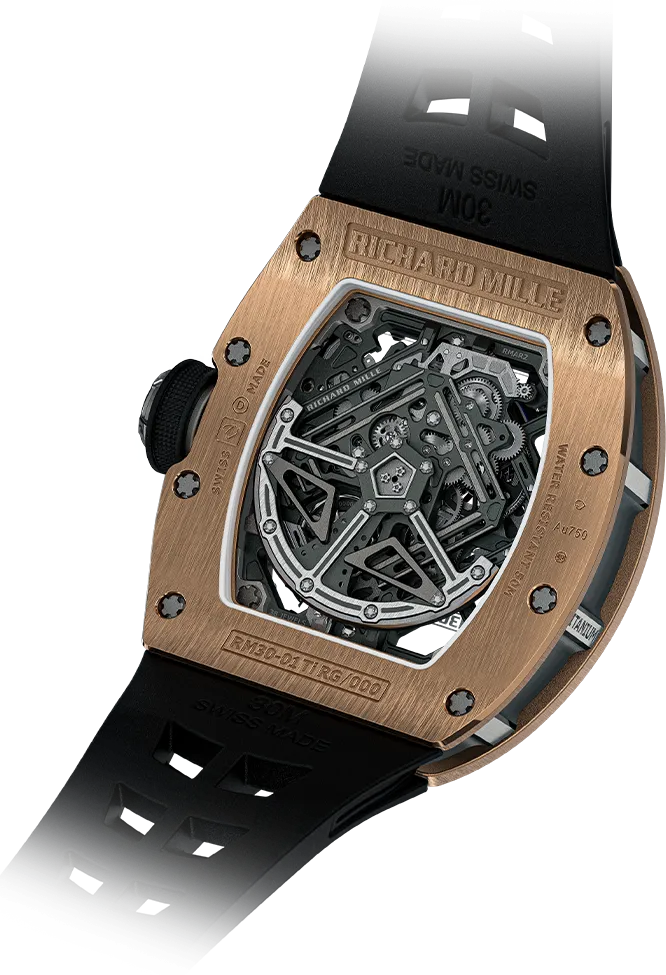
The RM 030 represents real progress in terms of performance. To develop a declutching rotor system – a dynamic continuation of the torque sensor already used in our tourbillon watches – had long been a dream of the brand.
The technical concept, here applied to an automatic watch, is closely linked to automotive mechanics. The innovation we hoped to achieve was to combine automatic clutching and declutching control of the winding system with a torque sensor, thus ensuring an ideal degree of spring tension for the perfect supply of torque to the movement.
- Reference
- RM 030 · RM030
- Year
- 2011
- Collection
- Historical models
- Family
- RM 30 · 3 references
- Complications
- Automatic
- Case size
- 42.7 × 50 × 13.95 mmWristcheck · Price guide
- Case material
- Titanium, Red gold, CeramicWatchonista
- Calibre
- RMAR1richardmille.com
- Winding
- Automatic
- Power reserve
- About 50 hoursrichardmille.com
- Water resistance
- 50 mWatchonista
- Colourways
Colourways & editions
9 known versions of the RM 030

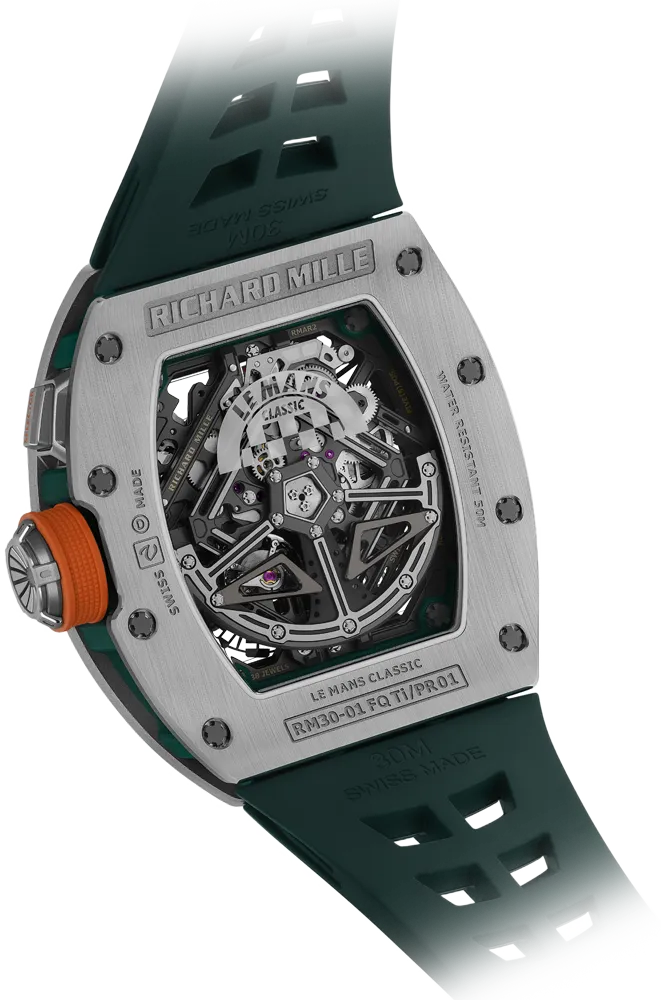
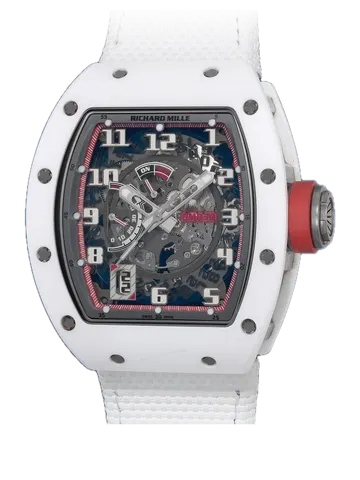
Le Mans Classic
White ATZ ceramic, carbon fibre flange; green and white
2014 · 100 pieces
Colourway pageSources +

Black Out
Black DLC titanium
Americas only
Colourway pageSources +
- WatchTime ↗
- Photo via Wrist Aficionado
- No photo yet
- No photo yet

- No photo yet
- No photo yet
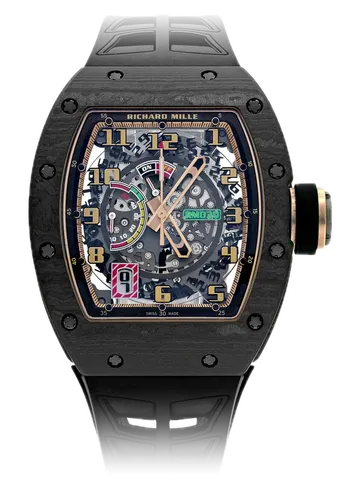
Carbon Ultimate Edition
Carbon
200 pieces
Colourway pageSources +
- Avi & Co. · RM 030 ↗
- Photo via Wrist Aficionado
The winding of an automatic wristwatch is accomplished by a small turning rotor, silently driven as a result of the physical movements of the wearer. These rotations of the rotor provide energy to the winding barrel, which reaches its optimal point once it is fully wound. After this point, overwinding can easily occur and needs to be avoided. This is traditionally achieved through the use of a sliding flange that allows the spring to slip, thus avoiding the movement becoming overwound. However, this traditional system allows the build-up of harmful debris inside the winding barrel as the flange releases the excess energy of overwinding during longer periods, especially when a person is particularly active. This in turn can severely affect chronometric results.
To avoid such adverse conditions, Richard Mille took four years to develop the concept and the design of a rotor that declutches automatically. With this system, the winding barrel is automatically disconnected from the rotor’s winding mechanism at the moment when the spring is fully wound. Additionally, this new mechanism is linked to the power reserve indicator to provide an optimal winding control. This allows both the movement and the oscillator to work with the best ratio of constant torque/power to provide the best chronometric performance.
The declutchable rotor works as follow: when the power reserve reaches 50 hours, the rotor is declutched automatically thanks to a specially developed gear system. As a result, the rotor is disengaged from winding the barrel. Conversely, when the power reserve decreases to 40 hours, the rotor is automatically clutched and the watch starts the winding phase until the indicator reaches 50 hours. It is possible to check theses phases thanks to the rewinding indicator located at 12 o’clock. It keeps the user informed whether the rotor is operating in winding phase (on) or is disengaged (off). Typical of Richard Mille, the declutchable rotor is a major innovation with its conception and miniaturization which represents an extraordinary technical challenge.
The caliber RMAR1, with 40 jewels and beating at 4Hz, has a free sprung balance with variable inertia. This type of balance wheel represents the ultimate in innovation. It guarantees greater reliability when subjected to shock and also during movement assembly and disassembly, hence better chronometric results over time. The regulator index is eliminated and a more accurate and repeatable adjustment is possible thanks to 4 small adjustable weights located directly on the balance.
The case of the RM 030 requires 86 swaging operations including 49 striking, before cutting and milling phases for the three main components (bezel, middle case, back). Machining requires 20 hours for the settings and it takes 30 hours for a kit programming. The empty case requires more than 255 tooling operations and more than 5 hours of glazing and polishing for the final phase. The complex shape of the case is obtained thanks to a complex 5 axis machine. For each case, the name “Richard Mille” engraved on the back of the case situated on the inside curve requires 45 minutes.
Technical specifications
CALIBRE RMAR1
Skeletonised automatic-winding movement with hours, minutes, seconds, date, winding indicator, power-reserve indicator and declutchable variable-geometry rotor.
Sources
Images and texts © Richard Mille.